


Conference report · Free ebook

Shaping the CX and AI vision for 2035: what does AI decide, and what do people keep? 12 sessions, 20 speakers and 10 things to do next, in 26 pages.
- Date
- Oct 2, 2026
- Venue
- The METT, Ho Chi Minh City
- Co-hosted by
 ×
×
 PDF · 26 pages
 Opening message from CXPA Global
CX Day message · Greg Melia, CEO, CXPA Global
CX in 2035 will not be decided by technology. It will be shaped by a community of practitioners who choose to shape it.
“Professions don't move forward through individual effort. They move forward when practitioners learn from each other and raise the standards together.”
Speaking by video ahead of CX Day on October 6, CXPA CEO Greg Melia called the summit a milestone: Vietnam now has 30 CCXPs, which puts it among the global leaders. He said the most important question is not proving value or winning influence, but keeping CX human as technology grows more powerful. CX professionals do not write the algorithms, but they bring the customer's view: does a solution remove friction, build trust and keep the brand's promise? Rather than predicting the technology of 2035, he asked the community to decide who it wants to be: operational specialists or strategic leaders.
What's inside
The whole conference in 26 pages
In 2025, VCXP Global Summit asked how AI would change customer experience. In 2026 the question has moved on: how do we make AI deliver experiences people can trust, and business results we can measure?
Over one day at The METT, 20 speakers from CXPA, Qualtrics, MoMo, Manulife, Aristino, DXCON, GEEK Up and Filum.ai followed the same thread: which work to give to AI, which to keep with people, and who is accountable when the machine gets it wrong.
This report brings the summit's 12 sessions together in one quick read: the big ideas, the numbers, the lines worth remembering and what to do next after each session.
session summaries
The big idea, three key points, the numbers and the most quotable line of each session, in agenda order.
panels, speaker by speaker
What each panelist argued: their position, three points and a quote of their own.
recurring themes
A theme map of what the day kept coming back to, and the numbers that cut across sessions.
things to do next
Concrete actions drawn from the whole conference, each tied to the session it came from.
Agenda
12 sessions, one thread: what to hand to AI, and what to keep for people
Open any session for its key points and most quotable line and, for the panels, each speaker’s position.
- 0113:30 · pre-recordedCX Day message
A message for CX Day, October 6, to the CX community in Vietnam
CX in 2035 will not be decided by technology. It will be shaped by a community of practitioners who choose to shape it.
 Greg Melia
“Professions don't move forward through individual effort. They move forward when practitioners learn from each other and raise the standards together.”
- A milestone for the professionVietnam's CCXP community shows that CX in the country has matured; the profession moves forward when practitioners learn and raise the standard together.
- Keeping CX humanCXPA's central question today: how to keep CX about people while making use of ever more powerful technology.
- Outcomes over technologyTools, methods and metrics all change; the core responsibility stays the same: helping the organisation make decisions that lead to good outcomes for customers, employees and the business.
- 0208:40 · on videoKeynote 1
What is still ours after AI?
After AI, what stays ours is what we choose to keep: strategy first, technology second.
 Heather Gillbanks
“An AI strategy is no different from any other kind of strategy.”
- AI is not an exceptionStrategy and change management for AI follow the same principles as any other strategy; technology is the last thing to worry about, not the first.
- Agree on the problem firstIf the organisation doesn't agree on the problem it is solving, every CX effort is wasted. Pick 3, at most 5, KPIs to keep the project alive when its cost is questioned.
- Pilots and accuracyDefine clearly what 'accurate' means and measure first-contact resolution; an AI assistant that gives wrong answers is worse than no AI at all.
- 0308:55Keynote 2
Using AI to drive customer experience management across the organisation
Not all AI is the same: understanding, guiding and acting are three different problems.
 Hoàng Anh Đức
“Customers can lie, but their behaviour doesn't.”
- From 'should we' to 'how'Last year the question was whether to use AI for experience at all; now it is how to apply it in practice to produce recommendations in real time.
- Feedback is wider than surveysFeedback includes text, images, voice and the traces of digital behaviour; behaviour often tells the truth more reliably than words.
- Analytical AI finds root causesNespresso found that customers kept calling back because one process pushed them onto an online channel, and fixed that process.
- 0409:20Keynote 3
The future of experience management: from listening to simulation
Like a Formula 1 team, CX has to simulate outcomes before acting, instead of analysing them after the customer has already left.
 Anass Bendemra
“What becomes hard to copy is the experience your customers consistently get from your organisation.”
- Experience is the advantage that's hard to copyAI capabilities that set a company apart 12 months ago are now available to everyone; what remains is an experience that stays consistent across every channel and every employee.
- Lessons from Formula 1F1 teams simulate scenario after scenario before a race; CX still asks for opinions first and analyses them when it is already too late.
- From understanding to shapingKeep the Listen – Understand – Act foundation, and add forecasting, prediction and orchestration within the moment itself.
- 0509:45Keynote 4
From “digital employee” to “digital colleague”
Hire an AI employee, give it a probation period and set it KPIs as you would a colleague: trust comes from capability it has proven.
 Lê Đức Minh
“Customers aren't annoyed at having to talk to AI; they're annoyed when the first thing they get back is an interrogation.”
- Chatbot or 'interrogation'A chatbot designed to collect information rather than solve problems erodes customers' trust in the brand, and in AI.
- Think 'employee' firstAssess AI as you would a candidate (experience, skills, fit), then let trust build over a probation period.
- Brain, hands and heartCompany knowledge, access to systems so it can actually get things done, and consistency and care at every hour.
- 0610:20Showcase 1
How Aristino came to “love” its customers in men's fashion retail
From selling clothes to designing moments in people's lives: ask customers who they want to become, not just what they want to wear.
 Phạm Tuyết Hạnh
“Don't only ask customers what they need to wear. Ask them who they want to become.”
- From centric to connectedAristino moved from customer-centric to customer-connected: understanding customers, empathising with them and staying alongside them more closely.
- Customers buy the values they live byThe 2035 customer wants to be understood, remembered and respected, and to express their values through what they own.
- The technology paradoxThe more technology there is, the more customers crave connection; most still see human interaction as very important.
- 0710:30Panel 1
What does AI decide, and what do people keep?
AI is only as smart as the definition of 'good' that people give it.


 Joe Black, Chris Elkin, Nguyễn Thanh Hằng
“Don't assume AI is smarter than you. You need to know what good looks like.”
- From reactive to predictiveIn 2035, an 'adaptive' experience is one where AI gets ahead of the need and adjusts in real time based on the customer's full history.
- Dirty data, bad decisionsThrowing everything at AI only produces rubbish; the urgent job is to clean and standardise the data, and AI itself can help with that.
- AI needs a probation periodRoll out in stages, supervise closely at first and only then widen its authority; customers must always be able to reach a real person straight away.
What each speaker said
Joe BlackFounder, DreamscopeAI lets experiences get ahead of what customers need, but people have to define “what good looks like” and always keep a way back to a person.
- The adaptive experience of 2035 anticipates needs; poor data leads AI to poor decisions, so clean the data first.
- The Revolut card story: AI handled an exception on its own initiative and refunded a USD 50 card fee, and the customer could always ask to speak to a real person straight away.
- Roll out AI in stages, the way you would coach an intern; but hand over too much and managers lose the information they need to make their own decisions.
“Teaching AI is like taking on an intern: not stupid, but green, and there's a lot it doesn't understand yet.”
Chris ElkinFounder, Doodle DesignThe value of AI depends on cross-functional teams co-creating with customers through human-centred design.
- The biggest barrier is teams not agreeing on why they are doing it; you need a cross-functional team that sees the whole journey and invites customers to co-create.
- The time staff save thanks to AI (the “AI dividend”) should go into the more meaningful parts of the experience or into complex tasks.
- At Marks & Spencer Singapore, staff are trained to spot pain points and use AI to guide customers to what they're looking for, instead of customers using AI on their own.
“We have guardrails for AI. What about guardrails for the people using it?”
Moderated by: Nguyễn Thanh Hằng — CX Executive & Advisor
- 0813:40Showcase 2
Designing trust into the customer journey
The best experience is not always the smoothest one; sometimes you have to slow the customer down on purpose.
 Hiếu Vũ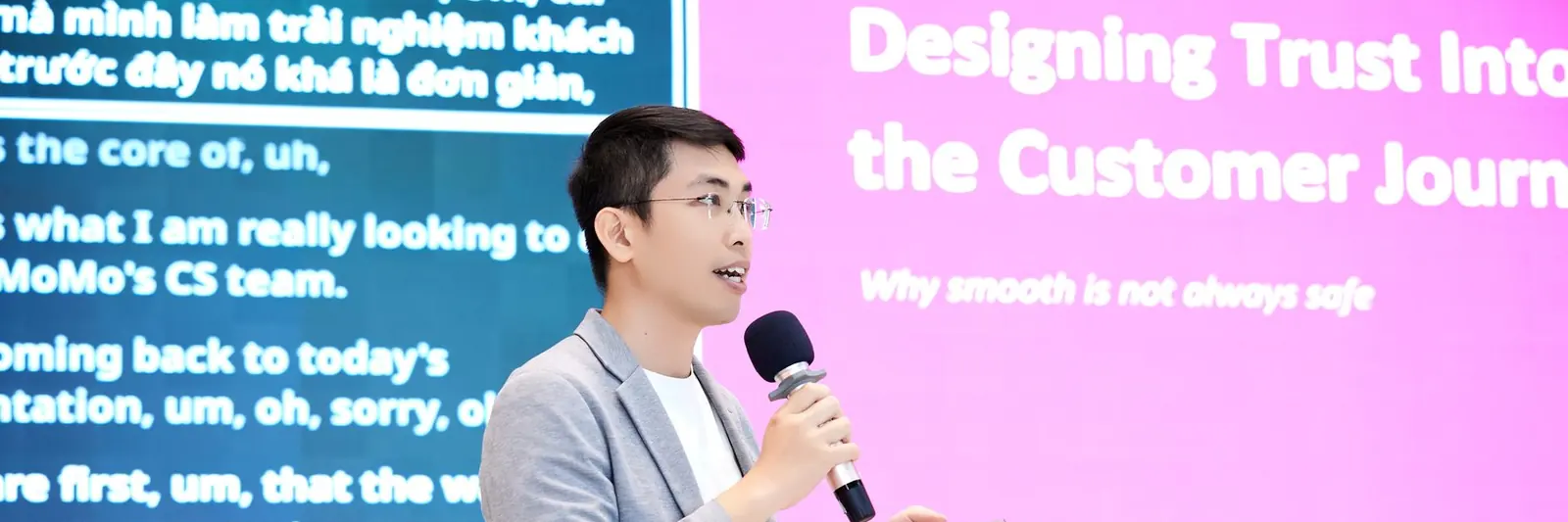
“The best experience isn't the smoothest one; sometimes all it takes is giving customers one more second, one more minute to think.”
- Reducing friction still mattersFewer steps and fewer unnecessary questions directly affect behaviour and sales; Tesla going from 64 clicks to 12 is a textbook example.
- Intentional frictionAt risky points, MoMo deliberately slows the journey by anything from a few seconds to a few tens of minutes to protect customers.
- Fraud is a CX problemMost victims transfer the money themselves and are very comfortable with technology; MoMo is the last touchpoint before the money leaves the account.
- 0914:05Panel 2
The CX career path: from learning the craft to the 2035 vision
AI shortens analysis, but it does not shorten the time it takes a CX professional to build real capability.


 Nguyễn Thanh Hằng, Phan Ngọc Minh, Phan Nhật Lệ, Hoàng Ngọc Vi Anh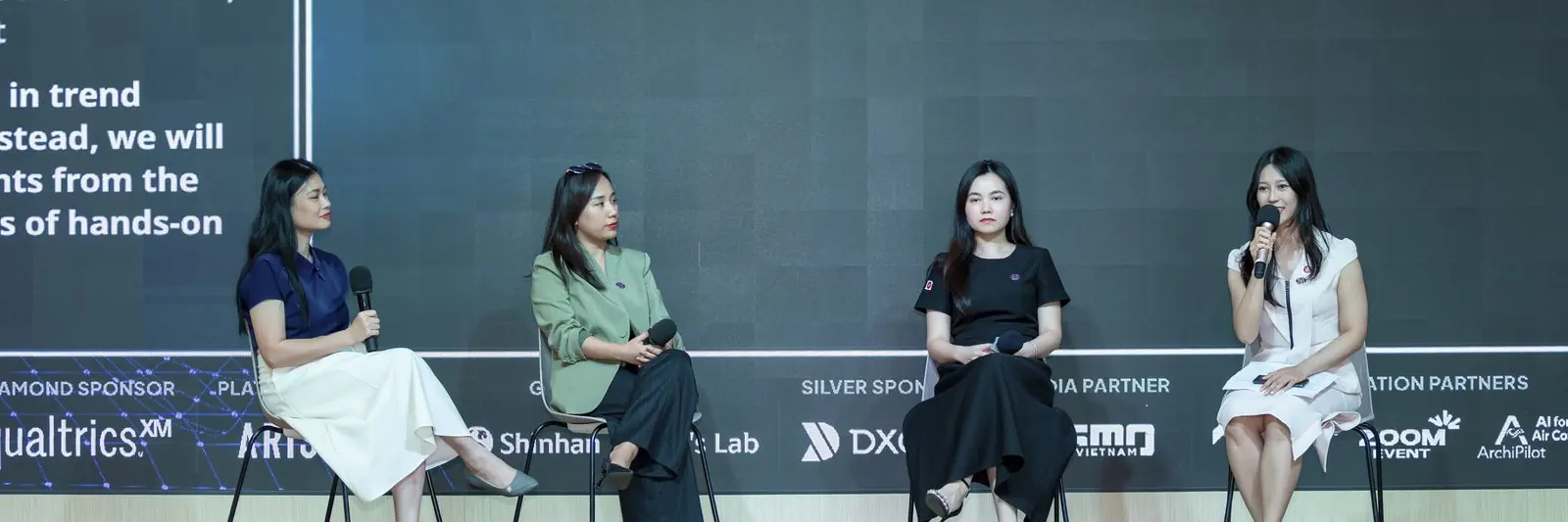
“AI can shorten the analysis, but it won't necessarily shorten the time it takes to build capability.”
- From manual to hybridIn the past you had to pick around 10% of feedback to read by hand; now AI scans all of it, but CX professionals still have to dig deep and make the call.
- Don't remove the apprenticeship ladderAI shortens analysis, but capability only forms through exposure to real data, being given authority and being held accountable.
- Buy needs an organisation that's readyHiring CX talent without giving them data access, a sponsor and clear goals is like bringing in a top doctor and not letting them see the medical records.
What each speaker said
Nguyễn Thanh HằngCX Executive & AdvisorAI shortens analysis but not the building of capability; by 2035 the CX function will be smaller but more influential.
- Give the same data set to three people using Claude, Gemini and ChatGPT and you get three different results; young professionals still need exposure to real data, real authority and real accountability.
- Hiring CX talent is necessary but not enough: it's like hiring a good doctor and not letting them see the medical records; the organisation needs data, a credible sponsor and specific goals.
- CX moves from downstream to upstream: seeing the journey across the 'rooms', taking part in business decisions, and building frameworks and tools for the business units.
“AI can shorten the analysis, but it may not make the process of building capability any shorter.”
Phan Ngọc MinhCX Advisor, CX at WorkAI can take over collection, analysis and reporting; CX professionals still have to govern, and outsourcing must come with a transfer of capability.
- She entered the field in 2015 at an experience measurement company, when Vietnamese customers were not yet used to leaving feedback or scanning QR codes, and many simply left without a word.
- Outsource when you need deep expertise, an urgent fix or a challenging outside view; but the experts must work alongside your team and transfer their skills, not become a 'black box'.
- Before CCXP she saw CX only as measurement and VoC; CXPA showed her that measurement is just one of five pillars, alongside ownership, initiatives and culture.
“You bring in experts and they solve the problem, but when they leave, what does the business have left?”
Phan Nhật LệCXPA Vietnam CommitteeCX work is now a combination of people and AI, but making decisions, going into the field and spreading CX across the organisation are still people's work.
- In retail she once had to read feedback and listen to sales calls herself and could only get through about 10%; now AI scans all the data, but you still have to step away from the screen and go into the field.
- Building a CX team from zero needs 'extended arms' in every department; the warning signs are enthusiasm that lives only in workshops, work that is only ever a project, and CX that sits only in the CX team.
- Learn 'What's in it for me' from the framework: instead of telling marketing to fix a message sent out of context, put it in their KPIs: lower conversion, higher cost.
“The departments are the musicians and the CX team is the conductor; without either one, there's no great music.”
Moderated by: Hoàng Ngọc Vi Anh — Chief Experience Officer, Zenify
- 1014:45Showcase 3
From “black box” AI to trustworthy AI
You can automate the work, but not the accountability: AI is a governance problem.
 Trần Văn Viển
“AI can automate a great deal, but when it comes to accountability, nothing can be automated.”
- Accountability can't be automatedThe Canadian airline chatbot case shows that AI is not an independent entity; when it gets things wrong, people and the business are still legally responsible.
- CX caught between two pressuresLeadership pushes for AI, while customers want a real person when the chatbot can't solve their problem.
- No all-or-nothing switchGiving AI full authority and switching it off entirely are both wrong; authority should be granted in parts, like a new employee's path through probation.
- 1115:25Keynote 5
Making customer experience part of the organisation's DNA
CX becomes part of the DNA when the experience promise is interpreted consistently, tied to strategy and backed by a way to govern it.
 Trần Phương Lan
“Many businesses have an experience promise, but it isn't interpreted consistently enough to guide action.”
- Saying is not doingPutting the customer at the centre only becomes real when the vision is communicated, with an action plan and specific KPIs across the whole organisation.
- A promise has to be measurable'Superior experience' needs to be spelled out: superior to whom, and measured how? For example, top 3 in the market on speed or on CSAT.
- Making CX strategy choicesChoose the segments, the priority journeys for the next three years and the difference you want to make; MB's '3C' principle is an example of clear direction.
- 1215:50Panel 3
When AI handles most interactions, which human capabilities can't be replaced?
When AI handles most interactions, people keep judgement, deep listening and the ability to redesign the experience.



 Lê Nguyên Thông, Nguyễn Nam, Tô Mạnh Tuấn, Jane Nguyễn
“In an age when AI is faster than people, don't try to race it on speed. Try to become more 'human'.”
- Three numbers from the fieldA B2B2C chatbot handles repeated questions; an AI assistant makes insurance advisors 1.4 times more productive; a contact centre scores 100% of calls instead of 1–2%.
- The contact centre becomes a sales channelBy reading every call, the business messages customers before they ask, and shifts its mix from 80–90% support to 70% sales.
- Three capabilities that can't be replacedJudgement when a situation goes beyond what AI can handle; the ability to redesign the experience; and listening deeply, even to what the customer doesn't say.
What each speaker said
Lê Nguyên ThôngHead of CX, Manulife VietnamAI makes advisors better, but the capability that can't be replaced is deep listening, and people remain accountable.
- The MSmart AI assistant serves ~50,000 advisors: user productivity is up 1.4 times, and new advisors close 32% more contracts in their first 60 days.
- The share of advisors using MSmart rose from 19% (in April) to 60%; the AI prepares policy illustrations and a 360° customer summary right in front of the customer.
- AI is not yet allowed to face customers directly: that needs correct and complete data, the right context and a named person who is accountable.
“When AI is faster than people, don't race it on speed; try to become more human.”
Nguyễn NamAI-Driven Transformation & D&T StrategistThe core capability of customer service people is judgement, within a multi-layered AI governance framework.
- More than 80% of questions from retailers and field sales are repeats; a context-aware chatbot cut handling time (from about 10 minutes to 3), with satisfaction at 4.3–4.4/5.
- Three-tier AI governance, before, during and after: incidents that people resolve are logged so the AI learns them as new scenarios (human-in-the-loop).
- Customer service will become a “customer relationship officer” role; identity data helps recognise VIP customers and anticipate what they are about to ask.
“Of the core capabilities for customer-facing people, the one I'd pick as most important is judgement.”
Tô Mạnh TuấnHead of DXCONAI frees the contact centre from repetitive work; the hardest capability in CX is understanding the situation and redesigning the experience.
- Before AI, a contact centre taking 80,000–300,000 calls a day could monitor only 1–2%; now it scores 100% of calls, and the number of supervisors has fallen by about 70%.
- The contact centre shifted from 80–90% support to 70% sales by sending messages proactively, before customers had to call and ask.
- He expects customer service headcount to rise: customers prefer people, and the work that is left is all complex; some companies cut 70% of their staff and then had to rehire.
“Understanding the situation and redesigning the experience will always be the hardest capability for any organisation.”
Moderated by: Jane Nguyễn — Strategic Partnership Development, GEEK Up
The day in one view
What does AI decide, and what do people keep?
AI does well
- Read and analyse100% of calls, feedback and digital behaviour, instead of a 1–2% sample
- Answer repeated questionsmore than 80% of customer service requests are repeat questions
- Simulate and predicttest options before the customer feels the effect
- Act within the authority it is givenlook things up, create draft orders, refund fees within policy
- Warn at the right momentstop a risky transaction before it is too late
People keep
- Define “what good looks like”AI is only as smart as the standard people give it
- Judgement and accountabilitythe work can be automated, the accountability cannot
- Hear what isn't saidempathy in the difficult moments
- Redesign the experienceconnect departments, like a conductor
- Put a name on every AI agenta person, not a department
Speakers
20 people on the CX Vision 2035 stage
From the global CXPA to the CX teams of MoMo, Manulife and Aristino; from DXCON, CX at Work, Zenify and GEEK Up to Qualtrics and Filum.ai.

Actions
10 things to do after the conference
- 01Start from the customer problem, not the tool
Set 3–5 KPIs for each AI initiative before you roll it out.
Keynote 1 · Keynote 2 - 02Give AI authority one task at a time
Start at advisory level or with human approval; widen its authority only when the numbers support it.
Showcase 3 · Panel 1 - 03Every AI agent needs a named owner
The CS team trains and runs the AI; IT looks after the infrastructure.
Showcase 3 - 04Give AI hands, not just a mouth
Open up system access so AI can resolve issues, not just make promises.
Keynote 4 - 05Clean your data before you scale AI
Bad data leads to bad decisions, at machine speed.
Panel 1 · Keynote 3 - 06Measure CX in money
Tie every CX programme to retention, cost to serve and revenue.
Keynote 3 · Keynote 5 - 07Keep deliberate pauses
Steps that are hard to undo need a slower beat so customers can decide for themselves.
Showcase 2 - 08Always offer a way out to a person
Hand over to a person, with the full context, when the customer is frustrated or the AI is unsure.
Showcase 3 · Panel 3 - 09Don't remove the apprenticeship ladder
Send young CX teams into the field and have them read real feedback.
Panel 2 · Keynote 1 - 10Bring CX to the leadership table
A CX council led by the most senior leader, meeting regularly and speaking in other teams' KPIs.
Keynote 5 · Panel 2
Moments
A day at CX Vision 2035









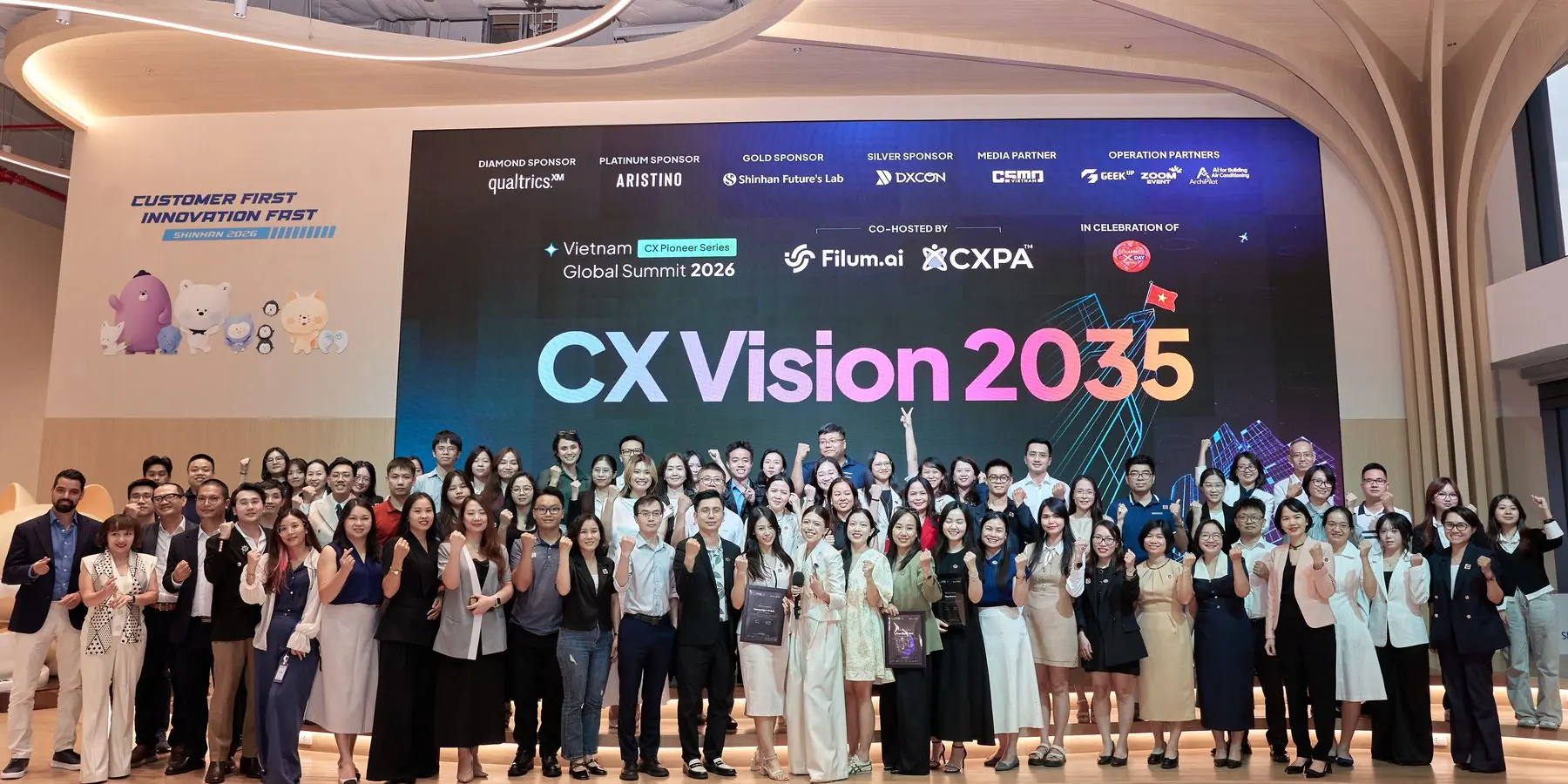
Free ebook
Bring the whole conference back to your team
Thank you for being part of VCXP Global Summit 2026. Share this report with colleagues who could not make it.
PDF · 4.7 MB · 26 pages
Thank you to our sponsors




And our partners


 GreenJump · ArchiPilot

VCXP Global Summit 2026 · CX Pioneer Series · In celebration of CX Day, October 6 · cxday.vn